
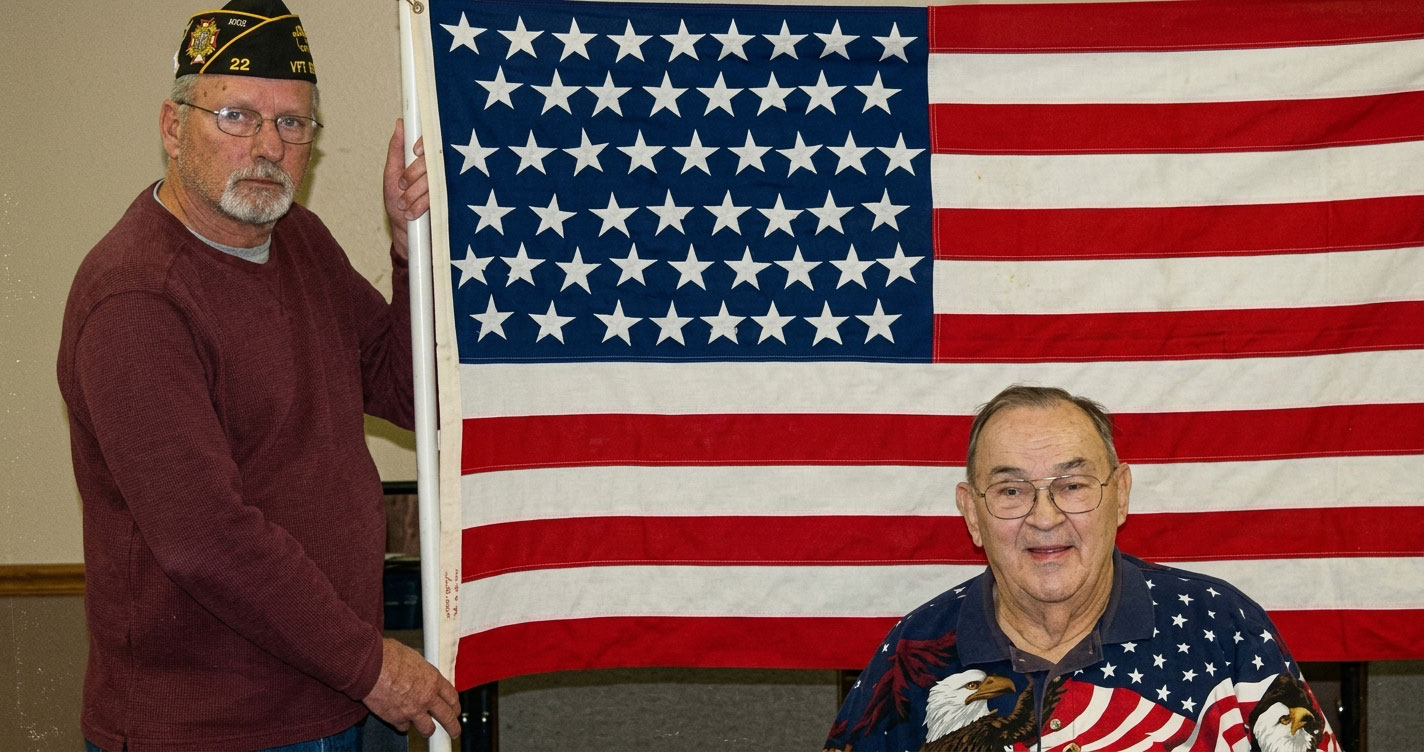
LANCASTER, Ohio, June 25 (DC Times Online) — If a state capitol is on your travel list, the story of the 50-star U.S. flag gives that stop a deeper meaning. The flag linked to Bob Heft began as a high school project in Lancaster, Ohio, but it later showed up above capitol buildings from Texas to Alaska, according to Heft’s own account and later reporting on the flag’s history.
How did a school assignment turn into the flag most Americans know today?
A school project in Ohio
In his StoryCorps oral history, Bob Heft said he was 17 and a junior at Lancaster High School when his history teacher, Stanley Pratt, assigned a project about flags. Heft said he decided to design a new 50-star U.S. flag because he expected the country would soon add more states.
Heft said his teacher gave him a B- and told him, “If you don’t like the grade, get it accepted in Washington then come back and see me.”
Heft said he then sewed the flag himself, even though he had never sewn before. In the StoryCorps interview, he said he asked his mother to show him how to use a sewing machine.
How it reached Washington
Heft said he mailed the flag to President Dwight D. Eisenhower in 1959 and asked him to adopt it for the nation’s new flag when Hawaii became the 50th state. Later accounts say Eisenhower’s chief of staff, Wilton B. Persons, sent Heft a thank-you letter.
Heft also said in later correspondence that he had made and flown the first 50-star flag in the United States and that it first flew on March 7, 1959. Those are Heft’s claims, not independently documented in the material reviewed for this article.
The flag became official on July 4, 1960, after the Eisenhower administration adopted the design.
Where travelers saw the flag
For travelers, the most visible part of this story is that Heft’s flag did not stay in a drawer. Fox News reported that Heft later got the flag flown over at least 40 state capitol buildings between 1960 and 1962, including in New York, California, Massachusetts, Michigan, Pennsylvania, Illinois, Mississippi, Alabama, Arkansas, Iowa, Utah, Nebraska, and Alaska.
One especially clear example came in Texas. Fox News reported that the flag flew for five hours over the Texas State Capitol in Austin on Oct. 5, 1960. Gov. Price Daniel said it would have stayed up all day except for rain and high wind, according to the account quoted by Fox News.
Another state-level confirmation came from Ohio. Fox News quoted Gov. Michael DiSalle as writing Heft that he was “pleased to verify your story that yours was the first 50-star flag displayed in Ohio on Ohio property.”
Why the story still matters for visitors
The route from Lancaster to Washington and then to state capitols around the country helps explain why the flag story still comes up at public buildings that many people visit on trips. State capitols are not only government sites; in this case, they were also places where a homemade design was displayed as the country prepared for a new official flag.
Some later retellings say the flag was flown over many more capitols and embassies, but the available accounts do not agree on the total. What is clear from the primary sources is that Heft believed his classroom project became part of the nation’s flag history, and that government officials in Washington and several states acted on that belief.
For anyone stopping at a state capitol on a road trip, that is the practical takeaway: the familiar 50-star flag has a specific American origin story, and part of it played out in public places that travelers can still visit today.


